The Prophet Who Sleeps
“The dream is the oracle we consult without meaning to.
The question is not what it reveals — but what it conceals.”
Have you ever woken in a cold sweat, certain you had seen something that hadn’t happened yet?
Maybe it was an accident. A face. A city you’d never visited — one you recognized the instant you first set foot in it. Maybe you dreamed of someone’s death, and days later, the phone rang with the news.
In that moment, a single question pierces through the mind like a needle:
How did I know?
It is one of the most unsettling experiences a human being can have. Not because it is supernatural — but because it feels like it is. And that feeling is precisely where the subtlest terror of all resides: what confuses us is not the unknown. It is what we think we know.
How a Dream Is Born — and Why That Matters
To understand why dreams seem to predict the future, we first need to understand what they actually are.
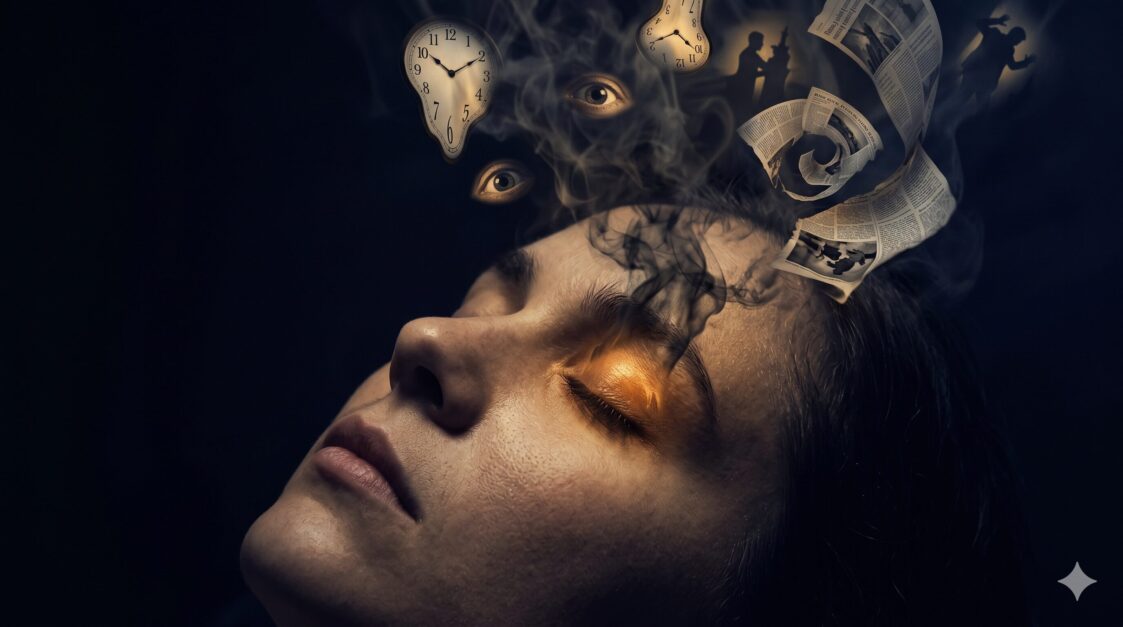
While you sleep, your brain does not rest. It processes. The hippocampus — the region responsible for memory — enters consolidation mode, reviewing everything experienced, felt, and observed throughout the day. Fragments of scattered experience are stitched into narratives. And the prefrontal cortex, the brain’s “rational” part, temporarily loses its grip on the process.
The result is a theater with no director.
Images, emotions, fears, and desires combine in ways that are absurd, poetic, and sometimes terrifying. The limbic system — the seat of emotion — takes the stage. Fear speaks loudest. Anxiety finds images to wear. Old traumas resurface dressed as fantasy.
Here is the first secret dreams keep: they are not windows into the future. They are mirrors of the present.
Your brain dreams about what you fear, what you desire, and what you are quietly processing beneath the surface. And that is precisely why some dreams seem to predict events — because anticipation and premonition are dangerously easy to confuse.
The Selective Archive of Memory
Imagine you have a mental archive of every dream you have ever had. Hundreds. Thousands, perhaps.
The truth is: you don’t.
Sleep neuroscience research suggests we forget between 90 and 95 percent of our dreams within minutes of waking. What survives in memory is what was emotionally intense — the frightening dream, the one that left a hollow feeling in the pit of your stomach, the one that made your heart race.
Now consider this: when something dramatic happens in your life — an accident, a loss, a diagnosis — your memory immediately begins scouring the past for signs. The brain asks: did I already know?
And it almost always finds something.
Not because you predicted it. But because you have dreamed about cars, about hospitals, about goodbyes, about catastrophes — as every human being regularly does. The archive was there. Memory simply pulled out what mattered now.
It is like throwing a thousand darts in the dark. Some will hit the target. And you will only remember the ones that did.
The Bias That Rewrites Memory
There is a cognitive phenomenon called hindsight bias, and it is one of the most powerful, most silent forces at work in the human mind.
Here is how it operates: after an event occurs, the mind automatically reconstructs the memory of prior events to make them seem as though they pointed toward that outcome all along. The process is involuntary, unconscious, and nearly impossible to resist.
In classic experiments, researchers asked participants to estimate the likelihood of certain historical events — both before and after learning the outcome. Those who already knew the result consistently overestimated just how “obvious” it had been all along.
Applied to dreams: after something significant happens, your memory of the prior dream warps, subtly. Details are amplified. Others dissolve. The vague dream about “something being wrong with someone’s health” becomes, in recollection, a dream about the specific illness your father developed three weeks later.
You were not lying to yourself. You were simply being human.
And the terror of it is exactly this: the mind does not consciously fabricate. It genuinely believes its own narrative.
The Mathematics of the Improbable
Let’s talk about coincidences — because they are not what they appear to be.
Consider this scenario: you dream about a car accident. Three days later, you see a serious crash on the news. Remarkable, right?
But before you conclude that you glimpsed the future, consider the variables you are ignoring:
How many times did you dream about accidents when no accident followed? Probably dozens.
How many accident reports have you consumed without having dreamed about one? Thousands.
How frequently do serious accidents happen every day, across the world? Often enough that any loosely related dream will find its match somewhere, in some headline.
The mathematician and philosopher David Hand calls this the Law of Truly Large Numbers: given a sufficiently large universe of events, any improbable coincidence becomes not merely possible, but inevitable.
Put simply: if one billion people dream every night, and each of them dreams about vaguely catastrophic events with some regularity, the number of apparent “hits” will be staggering — even if absolutely none of them are genuine premonitions.
We remember the hits. We ignore the avalanche of misses.
The archive was selective. The bias rewrote the story. And the coincidence was given the name of prophecy.
Why We Want So Badly to Believe
But perhaps the most disturbing question here is not scientific. It is psychological.
Why do human beings have such a visceral need to believe in prophetic dreams?
The answer touches something far deeper than intellectual curiosity. It reaches the very core of our most primitive fear: powerlessness in the face of the future.
We are the only species with a clear awareness of our own mortality. We know we will die. We know we will lose people we love. We know that events entirely beyond our control can, in seconds, destroy everything we have built.
Against that backdrop, the idea that we can sense what is coming is profoundly comforting. If dreams warn us, then the future is not entirely blind and deaf to our pleas. There is some order to things. There is some signal we can learn to read.
Ancient cultures understood this intuitively. In the Bible, Joseph interprets Pharaoh’s dreams. In Greece, the Oracle at Delphi received visions in sleep. In Mesopotamia, scribes recorded the dreams of kings as political documents.
This is not primitive superstition. It is psychological survival strategy.
Believing in omens gives human beings back a sense of control over what they cannot control. And the human brain will always prefer a comforting false narrative over a true and terrifying truth.
The problem begins when the narrative starts controlling behavior — when the dream becomes more real than reality.
The Thin Line Between Premonition and Paranoia
There is a delicate boundary between healthy intuition and pathological magical thinking.
The Babadook: When Grief Becomes the Monster
Our brains are extraordinarily skilled at pattern recognition. It is one of the traits that secured our evolutionary survival. The ancestor who learned to read the behavioral patterns of a predator outlived the one who ignored the signs.
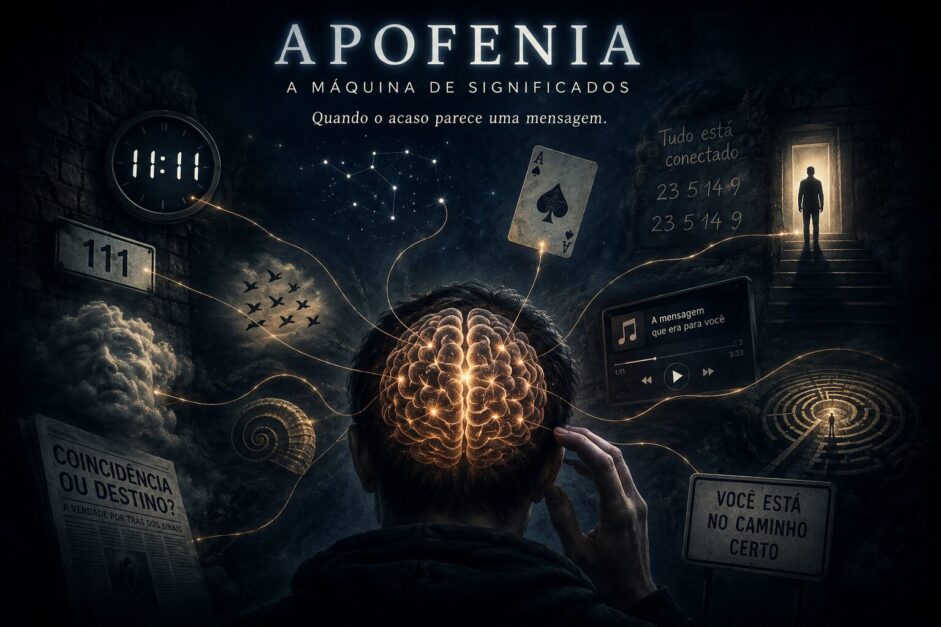
The cost of that skill, however, is that we see patterns even where none exist. Scientists call this apophenia — the tendency to perceive meaningful connections between unrelated events.
In normal doses, this produces creativity, intuition, and yes — that unmistakable feeling of “I already knew.”
In higher doses — particularly in states of deep anxiety, grief, or trauma — it can become something darker. The mind that believes its dreams dictate reality begins to live in service of them. It grows afraid to sleep. It interprets every dream image as a warning. The dream ceases to be a psychological phenomenon and becomes a tyrannical oracle.
The prophecy turns against the prophet.
What the Dream Actually Reveals
So we return to the original question: why do some people dream about events that seem to happen afterward?
The honest, scientific answer is: they don’t predict. They select, distort, and slot retroactively into a narrative that has already unfolded.
But there is a second answer — less obvious and, in its own way, far more fascinating.
Dreams reveal what our consciousness is processing before it can articulate it.
You unconsciously noticed your partner growing more distant. You registered, without consciously registering, that the car sounded different. You read something in the doctor’s expression that the words did not say. And your brain, in the night, converted those signals into images — into catastrophes, into losses, into goodbyes.
The dream did not predict. It computed.
And that may be more disturbing than any supernatural premonition: it means part of our cognition operates at a level our consciousness simply cannot access. There is a processing happening beneath the surface, silent and invisible, that sometimes erupts in the form of a dream and tells us what we already knew without knowing that we knew it.
The mind is deeper than we think.
And that is precisely where the terror lives.
Final Hook
Perhaps dreams do not show us the future.
Perhaps they reveal something stranger still: our hidden fears.
What if what you saw in that frightening dream was not a premonition of something yet to come — but a perfect reflection of something you already know, already feel, already dread, yet have not been able to face while awake?
The sleeping prophet does not see tomorrow.
He sees, with disturbing clarity, the today you chose not to look at.
And that, perhaps, is the hardest form of terror to bear: not the monster that comes from outside, but the recognition — in the darkness of your own dream — of a truth that the light of day did not have the courage to show.
In the next chapter — The Double: Why does the idea of a being identical to you provoke universal horror? From mythology to psychological disorder, we explore the fear of the mirror that thinks.
MIND AND FEAR | Chapter 2 of a series on Psychology, Terror, and the Abysses of Consciousness
By Kduborges