Why Does the Brain See Patterns That Don’t Exist? Have you ever looked at a cluster of stains on the wall and seen a face? Heard the sound of an air conditioner at three in the morning and swore someone was calling your name? Been alone in a dark hallway and felt something watching you from a corner you knew, rationally, was empty?
That behavior has a name. Has a history. And has a reason far deeper than you probably imagine.
The human brain is not a passive observation device. It does not record the world — it constructs the world. And in that construction, it makes systematic, predictable errors that, under certain conditions, look very much like the presence of something supernatural.
Pareidolia — the tendency to see meaningful patterns in random stimuli—is only the surface of a much larger system. A system architected over millions of years of evolution with a singular purpose: survive. And surviving, as we will see, required seeing threats even where none existed.
Pareidolia — The Scientific Name for What Scares You in the Dark
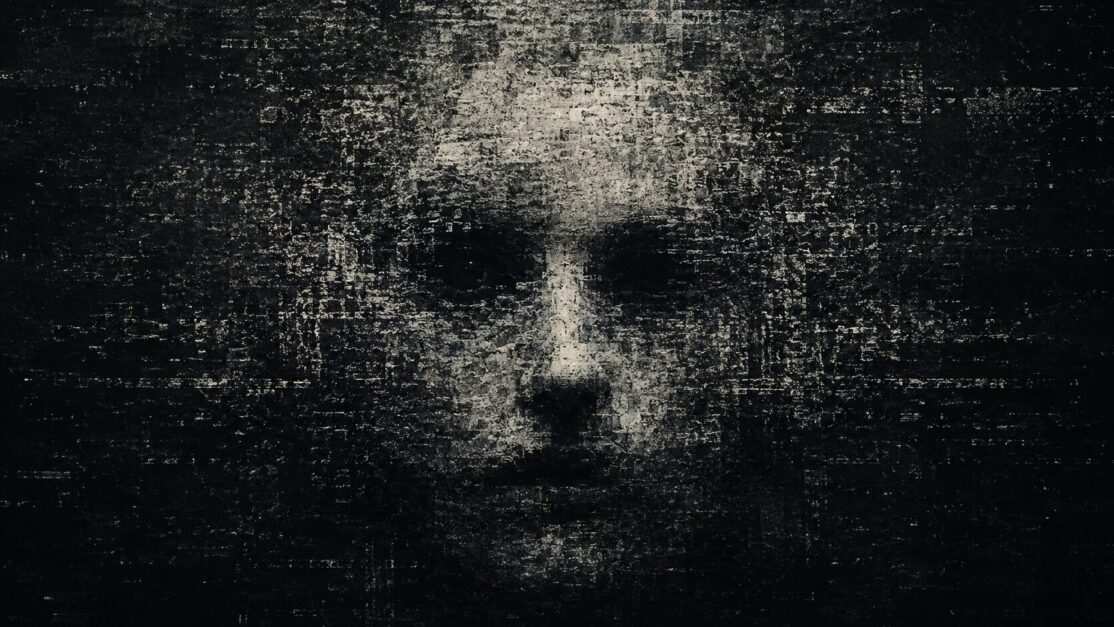
The term comes from Greek: “para” (beside, beyond) and “eidolon” (image, form). Pareidolia is the experience of perceiving a recognizable pattern — usually a human face or figure — within a vague, ambiguous, or random stimulus.
Examples are abundant and require no effort to find: the face of the Moon observed by cultures worldwide for millennia, the “Face on Mars” photographed by Viking 1 in 1976 (later identified as a common rock formation by higher-resolution images decades later), Jesus on toast, figures in wood grain, clouds shaped like animals. The phenomenon is universal. It respects no culture, intelligence, or declared skepticism.
This is important to retain: you can be a committed materialist, can know exactly what pareidolia is, and still see the face. Knowledge does not deactivate the mechanism.
The reason is that pareidolia is not a failure of reasoning — it is a perceptual operation. It occurs before conscious analysis. The visual system processes shapes, detects something resembling the configuration of two eyes, a nose, and a mouth, and sends a recognition signal to the cortex — and all of this happens in milliseconds, without your permission.
A study published in the Journal of Neuroscience in 2014, conducted by researchers at the University of Toronto, identified that the facial pareidolia process activates the same brain region responsible for recognizing real faces: the fusiform gyrus. The brain is not “pretending” to see a face. At that moment, it is genuinely convinced one exists.
Auditory Pareidolia: Hearing Messages in Noise
Pareidolia is not exclusive to vision. An equally powerful auditory version exists, and it lies at the root of one of the phenomena most exploited by paranormal enthusiasts: EVP capture, or Electronic Voice Phenomenon.
EVP is the practice of recording supposedly haunted environments and, when analyzing the audio, identifying fragments that sound like human voices — responses, whispers, names. The problem is that background noise, the hiss of an analog recording, wind passing through a gap — all of these sounds contain frequencies that, taken together, can be interpreted by the brain as speech patterns.
The same phenomenon underlies backmasking: the belief that certain songs, played backwards, contain hidden satanic messages. This moral panic swept the United States in the 1980s. None of the messages were intentional. What existed was a brain trained to detect language — identifying patterns in sounds that were never built to carry them.
Auditory pareidolia is also documented in natural sounds — storms, rivers, wind through trees. Ancient cultures frequently described these sounds as the voices of spirits or deities. That is not ignorance. That is neuroscience before the name existed.
The Brain Does Not Read the Present — It Predicts the Future
To understand why pareidolia exists, you need to understand how the brain processes information — and the answer is not what most people expect.
The dominant theory in neuroscience over the past decade is predictive processing, most robustly formulated by neuroscientist Karl Friston. The central idea: the brain does not process the world “bottom-up” — collecting sensory data and then interpreting it. It operates primarily “top-down”: generating constant predictions about what it should encounter, then using sensory data only to confirm or correct those predictions.
In direct terms: you do not see what is there. You see what the brain expects to be there — and the senses merely fill in the details.
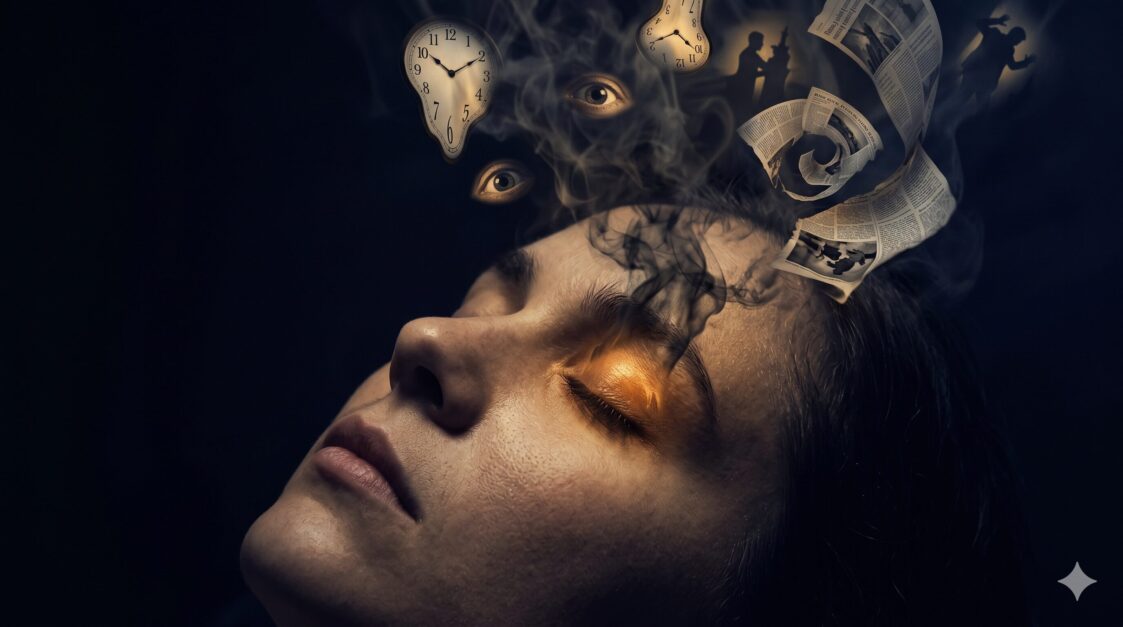
This has implications that go far beyond pareidolia. It means that all perception is, to some extent, a controlled hallucination. What we call “reality” is the brain’s predictive model being continuously calibrated by sensory data. When that data is ambiguous — a poorly lit hallway, a dark smudge in a corner, an indistinct sound from upstairs — the predictive model fills the blank spaces with what is most likely to be there.
And what does the evolutionarily trained brain consider most probable? In low-light environments, in heavy silence, in unfamiliar spaces? A threat. Always a threat.
Apophenia — When Connections Appear Without Existing
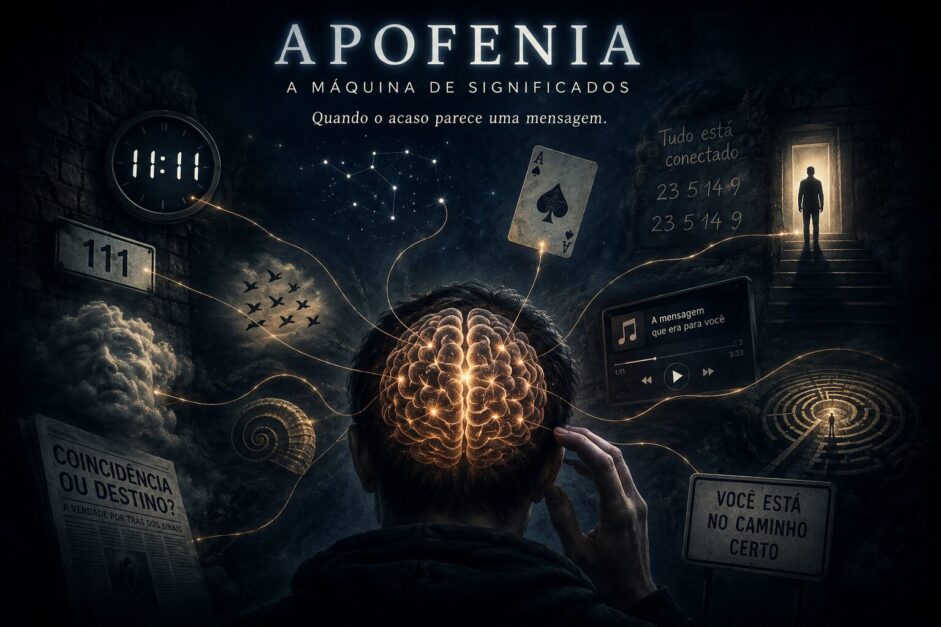
German psychiatrist Klaus Conrad coined the term apophenia in 1958 to describe the tendency to perceive meaningful connections between unrelated phenomena. Conrad initially observed it in schizophrenia patients at the onset of psychotic episodes — a state in which the brain begins seeing patterns in everything with overwhelming intensity, where each object and event seems directed specifically at the observer.
But apophenia exists on a spectrum. Milder versions occur in completely healthy people under stress, sleep deprivation, or simply in environments loaded with ambiguous stimuli. It is why casinos fascinate — and addict. Why conspiracy theories seem convincing from the inside. Why, sometimes, the sequence of events in a difficult week feels impossible to attribute to chance.
Pattern recognition, in its calibrated version, is one of the most sophisticated cognitive capabilities in biology. The same machine that detects real regularity can, under certain conditions, create regularity where only noise exists.
The Asymmetry That Kept Us Alive — Why Erring on the Side of Fear Is Evolutionary
Here we reach the core of the question. Why would a system as efficient as the human brain commit this type of error so frequently? The answer lies in the asymmetry of costs.
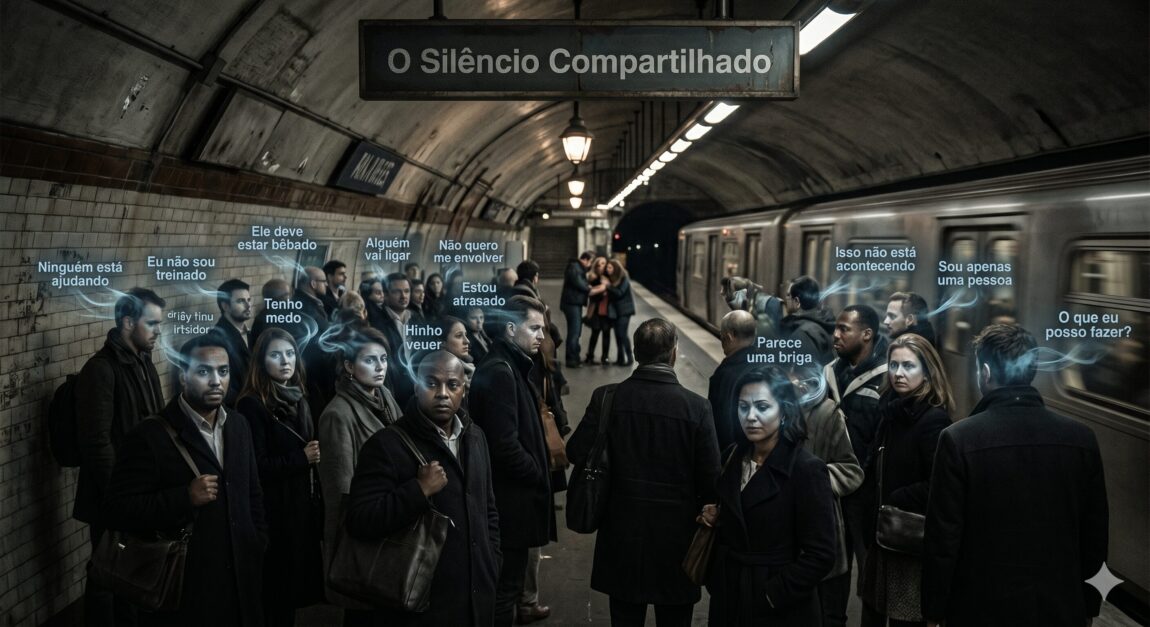
Imagine two scenarios. In the first, you hear a rustling in the bushes and assume it is a predator. You retreat. There was no predator — it was the wind. Cost: energy spent on an unnecessary escape, a few minutes of adrenaline, perhaps the food you left behind. In the second scenario, you hear the same sound and assume it is the wind. You do not retreat. There was a predator.
The cost of the two errors is not equivalent. A false positive — seeing a threat where none exists — is cheap. A false negative — not seeing a threat that does exist — can be fatal. Over millions of years, natural selection systematically favored organisms that erred on the side of alarm, not calm.
The result is a brain factory-configured to overestimate threats, to see agency where none exists, and to detect patterns even in pure noise.
This is not a manufacturing defect. It is, paradoxically, a deliberate feature of a system field-tested for ages.
HADD — The Agency Detector Running on Permanent Mode
Cognitive psychologist Justin Barrett developed the concept of HADD — Hyperactive Agency Detection Device. The idea is straightforward: the brain has a specialized system for detecting the presence of agents — entities with intention, that act, that may represent threat or benefit.
This system is hypersensitive by design. It was not calibrated for precision — it was calibrated for maximum sensitivity. And that hypersensitivity produces a predictable side effect: the brain sees agents where none exist. Faces. Figures. Presences.
Barrett argues that HADD is part of the cognitive foundation of religious and supernatural beliefs in general. The perception of a divine presence, a spirit, a ghost — all these experiences may be, at least partially, HADD firing in ambiguous situations. Not as proof that such entities do not exist. But as an explanation for why we are, as a species, so persistently inclined to perceive them — regardless of religion, culture, or historical period.
Apparitions, Shadows and Supernatural Phenomena — What Happens When the Filter Fails
The step from “seeing patterns where none exist” to “seeing a ghost” is smaller than it seems. And it is traversed frequently by perfectly sane people.
Sleep paralysis is one of the most well-documented phenomena in neuroscience and one of the most terrifying to experience. It occurs in the transition between sleep and wakefulness, when the mechanism that immobilizes the body during REM — to prevent you from physically acting out your dreams — remains active while consciousness returns. The result is the sensation of being fully awake, unable to move a single muscle, frequently accompanied by vivid, terrifying hallucinations.
And what is the most common content of those hallucinations? A presence in the room. A dark figure in a corner. Something approaching the bed. In many cases, an entity sitting on the chest, making breathing difficult. This explains the cultural universality of figures like the medieval European Incubus, the Old Hag of English folklore, Japan’s Kanashibari, and Brazil’s Pisadeira — a shadowy creature from Brazilian folklore said to crouch on sleeping victims. Cultures that never communicated described the same entity because they were experiencing the same neurological mechanism.
Sleep paralysis is not rare. It is estimated that between 7% and 40% of the population has experienced it at least once. It is most frequent during periods of stress, sleep deprivation, and disruptions to the circadian cycle. And the experiences it produces are, to those who live them, completely indistinguishable from reality.
Infrasound, Electromagnetic Fields and the Environment That Manufactures Fear
In 1998, engineer Vic Tandy, working in a laboratory in Coventry, England, began feeling inexplicably uncomfortable in the space. Diffuse anxiety, nausea, disturbed peripheral vision — and the distinct sensation of not being alone. Investigating the source of his discomfort, he discovered that a recently installed fan was emitting infrasound at a frequency of 18.98 Hz. Close to 19 Hz — a frequency that resonates with the human eyeball, causing visual distortions and sensations of dread that have no identifiable origin for the person experiencing them.
Infrasound — sounds below the 20 Hz threshold, inaudible to the human ear but detected by the body — was subsequently investigated in relation to reports of hauntings in specific environments. Not as a definitive explanation for all phenomena, but as a variable that concretely interferes with perception.
Neuroscientist Michael Persinger conducted experiments in the 1980s and 1990s using what became known as the God Helmet — a device that applied weak electromagnetic fields to the temporal lobe. Most subjects reported sensations of a presence in the environment, of being watched, mystical experiences, or the feeling of leaving the body. Some reported specific encounters with figures or entities.
A disturbed temporal lobe — whether from electromagnetic fields, fever, oxygen deprivation, focal epilepsy, or extreme exhaustion — produces exactly the type of perception that, outside the laboratory, would be attributed to an apparition.
These findings do not resolve the deeper philosophical question of what does or does not exist. They do resolve, at least partially, the question of why human beings perceive things even when no instrument detects anything.
The Brain as a Narrative Machine — and the Price of That Architecture
There is a mechanism in the left hemisphere of the brain described by neuroscientist Michael Gazzaniga as the “interpreter.” Gazzaniga identified it across decades of research with patients whose corpus callosum had been surgically severed — people whose two hemispheres were separated to treat severe epilepsy.
The interpreter is the system that constructs narratives. It observes the body’s behavior — actions, emotions, perceptions — and generates a coherent story that explains them. Even when that story is fabricated.
In one of Gazzaniga’s experiments, a patient’s right hemisphere received the instruction “stand up and walk.” The patient stood. When asked why he had stood up, the left hemisphere — which had no access to the original instruction — immediately and with complete conviction replied: “I wanted to get a drink.”
There was no drink. There was no prior intention. There was only the interpreter generating a plausible narrative for a behavior it did not understand. And here is the most disturbing point: the patient was not lying. He completely believed what he said.
Why Ambiguity Is the Central Ingredient of Horror
The architecture of the interpreter explains something every horror writer understands intuitively: what is not shown frightens far more than what is shown. A creaking door frightens more than the revealed monster. The silhouette in the hallway is more unsettling than the illuminated face. The sound from upstairs does more with the imagination than any explicit scene.
The reason is that the interpreter, faced with ambiguity, fills the blank spaces. And what it fills them with is calibrated by context, memory, emotional state — and by the entire evolutionary history of a being that survived precisely by assuming the worst.
Confirmation bias amplifies the process in chain: once the brain has adopted an interpretation — there is something in that room — it treats every new piece of data as confirmation. The next sound. The temperature drop. The very acceleration of the pulse, which the interpreter uses as evidence that the fear was justified. Each detail is incorporated into the existing narrative rather than evaluated independently.
Coincidences are also not neutral in this system. The brain does not store coincidences as statistical curiosities — it organizes them into patterns. When three strange things happen in sequence, the interpreter does not see three random events. It sees the beginning of a series. An intention. A signal directed specifically at you.
This is how the human mind constructs supernatural experiences without the participation of anything supernatural.
The Ghost Hunter Living Inside Your Head
Everything described here — pareidolia, HADD, predictive processing, apophenia, the narrative interpreter, infrasound, sleep paralysis — points to the same central conclusion: the human being is not a neutral witness to the world. We are active constructors of reality, operating with a set of tools calibrated for survival, not for accuracy.
This constructor is efficient. Incredibly sophisticated. And, under certain conditions — darkness, ambiguity, exhaustion, isolation, fear — it fabricates. It sees faces where there is wood. Hears voices where there is static. Senses presence where there is only air.
This is not weakness. It is, paradoxically, the record of a strength: the capacity of a biological system to make decisions in fractions of a second, with incomplete information, in a potentially hostile environment. For millions of years, this system worked. It worked so well that we are here to document it.
The price is that it cannot turn off.
And when the darkness closes in, when the silence grows too heavy, when you are alone in a space you do not know — the ghost hunter inside your head gets to work. Without permission. Without pause. Without distinguishing between the real and the constructed.
It does not need real ghosts.
It creates its own.
What if some of the things we call mystery are simply the brain working overtime?
The question is not rhetorical. It is scientific. And depending on the answer you are willing to accept, it changes everything — including what you will feel the next time you wake in the middle of the night and swear there is something in the corner of the room.
Chapter 2 → What happens in the brain during extreme fear: cortisol, the amygdala, and the emotional hijack.