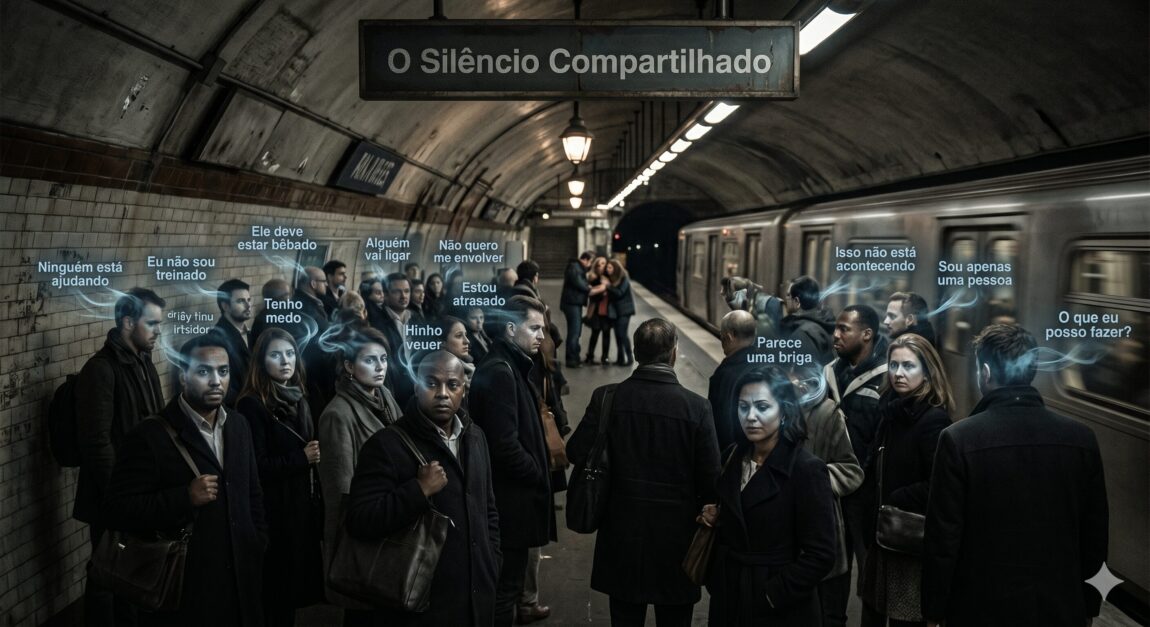
From the House of Mirrors series.
The House of Mirrors at Imperial Park closed at eleven, but the ticket attendant never looked at the clock while there were still people inside. That was why Marina stayed. Not because she wanted to see herself distorted—she laughed too much at that, at the legs stretching to the ceiling, at the head shrinking like a deflated balloon—but because outside, someone was waiting for her, and inside those corridors of warped glass, at least the wrong version of herself was the mirror’s choice, not the audience’s.
She had called Daniel three times that afternoon. Three unanswered calls. Not because he was busy—she knew, thanks to his WhatsApp status, that he was online, typing to someone, just not to her—but because he had decided, without warning, that this would be a week of silence. Marina knew the pattern. Every time he pulled away, even slightly, she felt the ground disappear beneath her feet, as though the validity of her own existence depended on a notification.
Lost in those thoughts, she entered the eighth corridor.
The first seven mirrors were exactly what she expected. She laughed at the belly that turned into a ball, at the mouth stretched like elastic. It was domesticated terror, the kind people pay to feel because they know exactly where it ends.
The eighth mirror did not distort the body.
Marina stopped in front of it, waiting for the usual effect—the stretching, the flattening, the visual joke—but the glass showed something different.
It showed Daniel.
Clear. Complete. Smiling with the smile he reserved for moments of genuine happiness, not mere politeness. In the reflection, he stood beside her.
She, however, was blurred.
Not distorted—absent.
A trembling outline, like a photograph taken in motion, while he remained perfectly in focus.
“That’s not fair,” she said aloud to the glass, immediately feeling ridiculous for speaking to an amusement park mirror.
The mirror did not answer.
It only showed.
Marina stepped closer. The nearer she came, the sharper Daniel became, and the more she dissolved around the edges—as if proximity to him cost her definition. A cruel exchange: his clarity increased in exact proportion to her disappearance.
She thought about walking away. Thought about laughing it off as another optical trick from a fading park. Yet something about the image felt familiar, drawn from somewhere older than that night—from the years she tried to be interesting enough to make her parents argue less, from the years she memorized compliments she hoped to hear in return, from the more recent years when she measured her worth by the speed of Daniel’s replies.
“I’m not blurred,” she whispered. “I’m just waiting for him to confirm that I’m real.”
At that exact moment, the image changed.
Daniel did not disappear. He simply lost importance. He shrank into a corner of the glass, small and decorative, like a footnote on a page that had suddenly discovered its true title.
At the center of the mirror stood a woman.
Marina.
But not the Marina she knew.
Not the one who checked her phone every three minutes.
Not the one who collected praise like oxygen.
Not the one who had learned, as a child, that being loved required editing herself.
This woman carried her shoulders differently—open, unapologetic, taking up space without asking permission. A small scar on her chin, usually hidden beneath makeup, was visible here, worn almost like a signature. She wore a color she had loved as a teenager and abandoned because someone once joked that it “didn’t suit her.”
Her eyes did not search the edges of the frame for approval.
They looked directly at Marina.
Calmly.
Almost unbearably so.
“Who are you?” Marina asked.
The woman did not answer aloud.
Her lips moved, and Marina understood:
I am who you would have been if you had kept choosing for yourself.
A pressure tightened in Marina’s chest. Not fear.
Something closer to grief.
The grief for a person who never truly died, yet was abandoned little by little—decision by decision, compliment by compliment—every time she chose someone else’s opinion over her own desire.
She wanted to blame the mirror.
To call it cruel.
To dismiss it as another cheap trick.
But she knew the truth.
The mirror was innocent.
It only reflected what it saw.
The one who saw Daniel where Marina should have been, the one who believed her value depended on unanswered messages, the one who shrank herself to fit inside other people’s comfort—that had never been the mirror.
That had always been her.
“I let all of you tell me who I was,” she said, not to the glass, but to every voice she had collected throughout her life—parents, lovers, friends, passing comments she had preserved as permanent verdicts. “And somewhere along the way, I stopped asking myself.”
The woman in the mirror did not smile. Did not comfort her. Did not celebrate.
She simply remained there.
Clear.
Present.
Waiting—not to be validated, but because she had never needed permission to exist.
And Marina finally understood what it meant to reclaim custody of herself.
It was not about removing Daniel from the image.
It was not about pretending she no longer wanted to be seen, loved, or chosen.
It was about no longer treating her worth as borrowed property, something that needed constant renewal whenever someone withdrew, went silent, or walked away.
It was about choosing, for herself, to become the woman with open shoulders.
Not because the mirror demanded it.
Because she finally allowed it.
“I want to be you,” she said softly.
Then she realized the sentence was wrong.
This was never about becoming someone else.
It was about stopping herself from being who she already was.
She took a breath and corrected herself.
“I’m going to be me. Exactly me. In every way.”
The mirror did not celebrate.
Mirrors never celebrate.
They only return what stands before them.
Yet for a brief moment, one she chose not to question, the outline of the woman and the outline of Marina aligned perfectly, like two photographs of the same person taken years apart, finally brought into focus.
She left the House of Mirrors without looking back.
Not because she feared what she might see.
But because, for the first time in a very long time, she did not need a second confirmation.
The park was closing. Lights went dark one panel at a time.
On her way to the parking lot, she passed a dark shop window that still reflected the night.
She looked deliberately.
The woman with the open shoulders was there.
Looking back.
Calm as ever.
Her phone vibrated in her pocket.
Without checking, she knew it was Daniel.
She did not answer immediately.
First, she finished seeing herself.