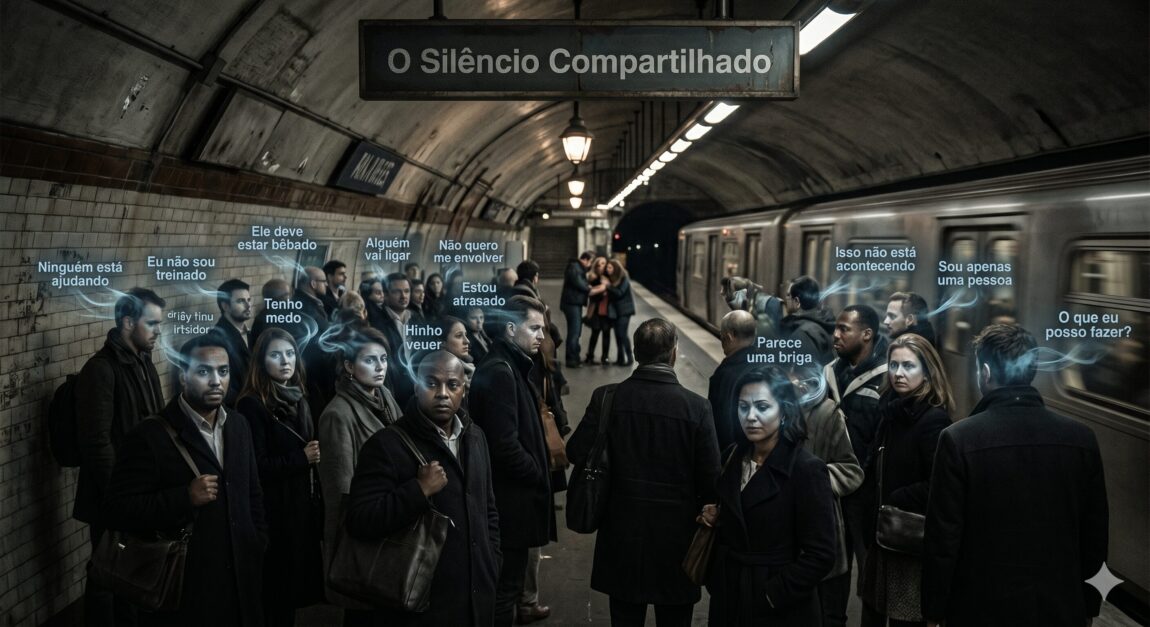
Imagine standing in a crowded subway station or a bustling city square when a sudden, desperate scream cuts through the ambient noise. Your heart leaps, your adrenaline surges, and your instincts scream at you to look, to act, to help. But as you turn your head, you notice something deeply unsettling: no one is moving. Dozens of eyes are wide, locked onto the horror unfolding before them, yet every single body is suspended in a state of absolute, petrified stillness. The silence of the crowd is not merely quiet; it is a heavy, suffocating entity that wraps around your throat, choking out any impulse to intervene.
This is the psychological horror of the bystander effect, a phenomenon often discussed in sociology but rarely examined through the cold, clinical lens of neuroscience. It is the terrifying realization that our individuality is incredibly fragile, easily dissolved by the presence of others. When tragedy strikes in a crowd, we do not become a powerful force of collective rescue; instead, we often mutate into a monolithic monument of paralysis. This collective silence is a chilling reminder of how easily our moral agency can be hijacked by the quiet consensus of the herd.
What lies beneath this terrifying inertia? It is not simply apathy or cowardice, as we so desperately want to believe to preserve our self-esteem. Rather, it is a complex, almost sinister interplay of neurological misfires and evolutionary programming that turns a group of rational human beings into accomplices of tragedy. To truly understand this horror, we must peer into the dark, damp corridors of the human brain, where the survival mechanisms of our ancestors have evolved into a silent, modern trap.
When the Brain Freezes: The Neurology of Silence
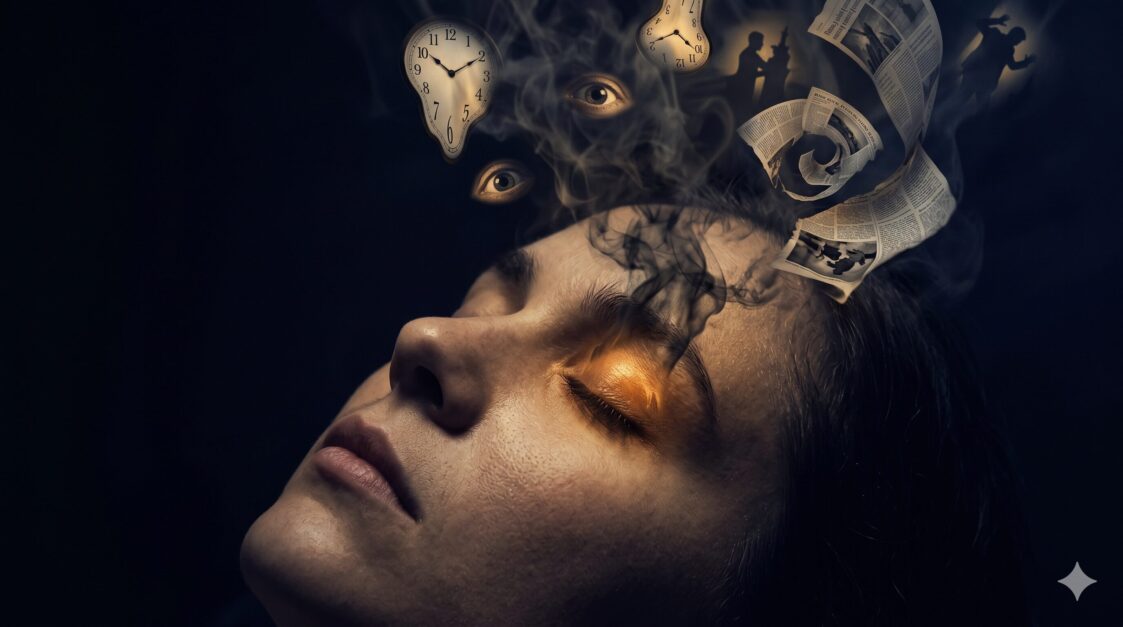
When we witness an emergency, our brain undergoes a violent, internal civil war. Instantly, the amygdala—the ancient, almond-shaped alarm system of the brain—detects danger and fires a barrage of distress signals, preparing us for fight or flight. However, when we are surrounded by a silent crowd, a secondary, much more insidious signal is generated. The prefrontal cortex, responsible for social cognition and evaluating the behavior of others, frantically scans the environment for cues. Seeing no one else react, the brain misinterprets this collective inaction as a sign that the danger is not real, or that action is inappropriate, triggering a profound, neurochemical freeze response.
This freezing is not just a metaphor; it is a literal, physiological lock. The periaqueductal gray (PAG), a brain region critical for coordinating threat responses, can override the motor cortex, paralyzing the body in place. In a state of social conformity, the brain’s error-detection network—specifically the anterior cingulate cortex (ACC)—becomes hyperactive. The ACC registers the potential embarrassment or social deviance of acting alone as a threat equivalent to physical pain. Consequently, the brain decides that breaking the collective silence is a greater danger to our social survival than the actual physical emergency unfolding before us.
The horror of this neurological freeze lies in its involuntary nature. We like to believe we are masters of our actions, yet in these critical moments, our brains actively suppress our agency. Neuroimaging studies reveal that during collective paralysis, the neural pathways connecting empathy to action are effectively muted. The brain blocks the transition from feeling someone else’s pain (empathy) to doing something about it (compassion), trapping us in a biological cage of our own making, where we watch, horrified but utterly unable to move.
The Dark Psychology of Our Shared Paralysis
Beyond the firing of synapses lies the psychological architecture of our shared paralysis, dominated by two twin demons: pluralistic ignorance and the diffusion of responsibility. Pluralistic ignorance is a collective delusion where everyone privately disagrees with the crowd’s inaction but assumes everyone else knows something they do not. We look to our neighbor for guidance, unaware that they are looking at us with the same desperate, blank stare. In this feedback loop of ignorance, the silence of the crowd becomes a self-fulfilling prophecy, validating the lie that nothing is wrong, even as the victim’s cries grow weaker.
If pluralistic ignorance blinds us, the diffusion of responsibility paralyzes our hands. When we are alone, the moral burden of an emergency rests entirely on our shoulders; if we do not act, the blame is ours alone. But in a crowd, that burden is divided, fractured into a thousand microscopic pieces until it becomes weightless. The brain performs a swift, subconscious calculation: “With so many people here, surely someone more qualified will step forward.” This psychological math dilutes our personal accountability to near zero, allowing us to stand by and watch unspeakable horrors without feeling the immediate, crushing weight of guilt.
This dilution of responsibility reveals a deeply disturbing truth about human nature: our sense of morality is highly contextual and terrifyingly fragile. We are social creatures to a fault, so desperate to belong and conform that we will gladly sacrifice our ethical compass to avoid standing out. The crowd becomes a shroud of anonymity, a psychological mask that shields us from our own conscience. Under the influence of this shared paralysis, we are no longer individuals with free will; we are merely cells in a larger, indifferent organism that watches tragedy unfold with cold, unblinking eyes.
The terrifying reality of collective silence is that it can happen to anyone, at any time. We are all susceptible to the neurological and psychological traps that turn bystanders into silent accomplices. It is easy to look back at historical atrocities or modern-day public tragedies and condemn the onlookers as monsters, but the science suggests a much more uncomfortable truth: they were simply human beings whose brains functioned exactly as evolution designed them to. The line between a hero and a silent bystander is not a chasm of character, but a fragile neural pathway that can be easily severed by the presence of a crowd.
This realization leaves us with a haunting question that lingers long after the crowd has dispersed. If our brains are wired to freeze, and if our psychology is designed to diffuse responsibility, how can we ever trust the strangers around us—or even ourselves—in our moments of greatest need? The next time you find yourself in a crowded space, look around at the faces of those passing by. In a crisis, those same faces may turn toward you, not with hands outstretched to help, but with the vacant, petrified stare of the paralyzed herd.
Ultimately, the fear of collective silence is the fear of our own inherent helplessness. It is the realization that in the moments that define us, we may find ourselves trapped inside our own skulls, screaming at our limbs to move while our biology holds us hostage. To break this spell requires more than just good intentions; it demands a conscious, violent rebellion against our own evolutionary programming. Until we learn to recognize the cold grip of the collective freeze, we remain at the mercy of the silence—a terrifying, quiet monster waiting for the next scream to begin.